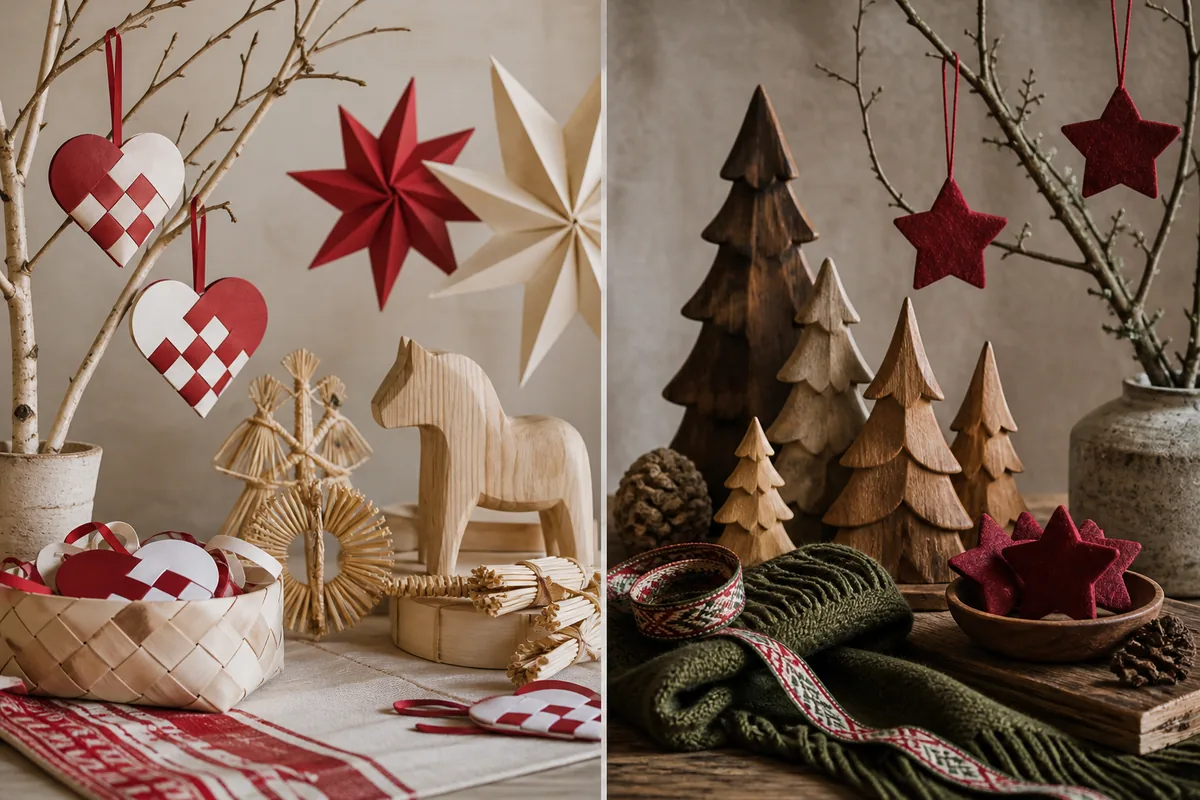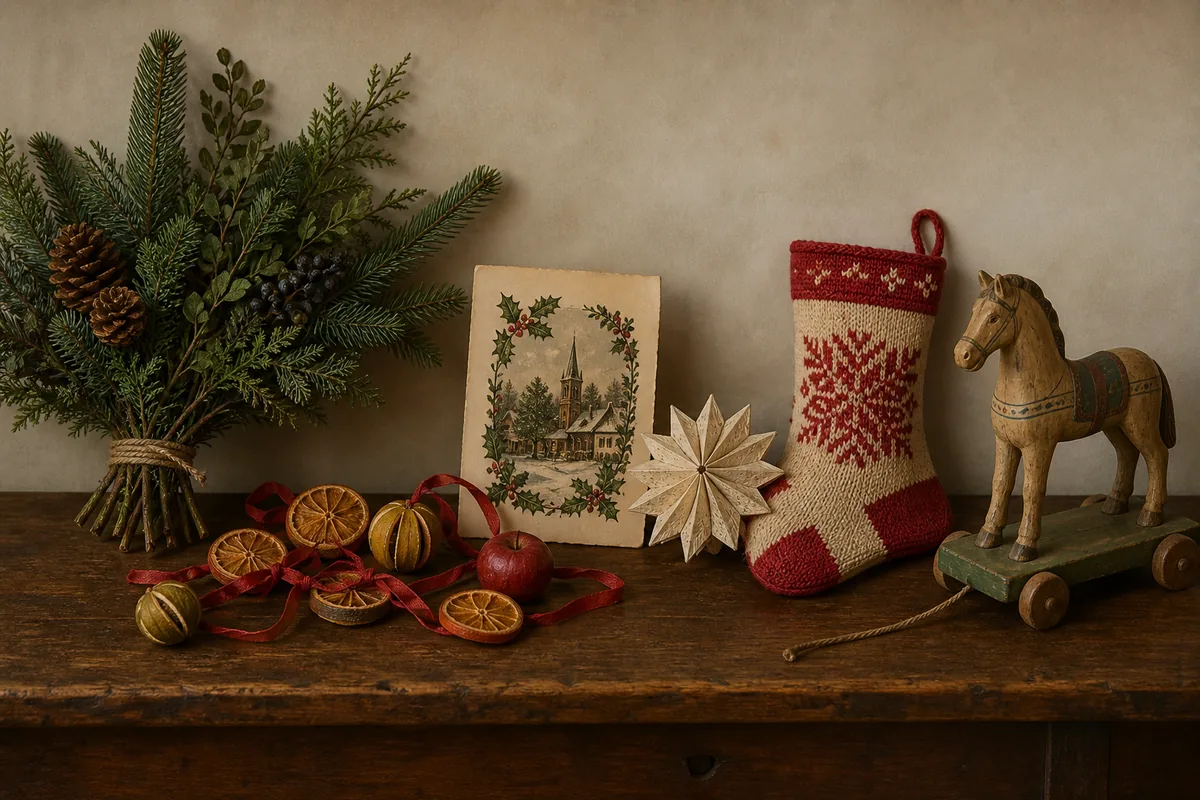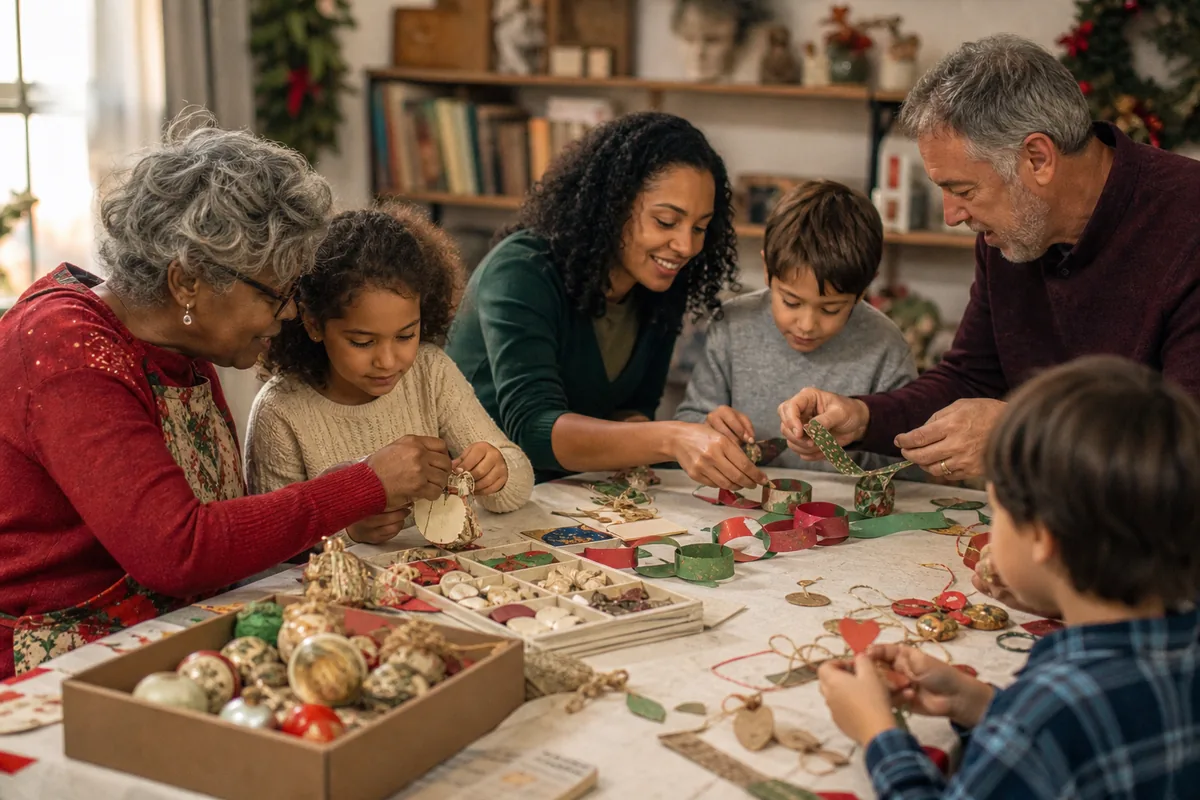
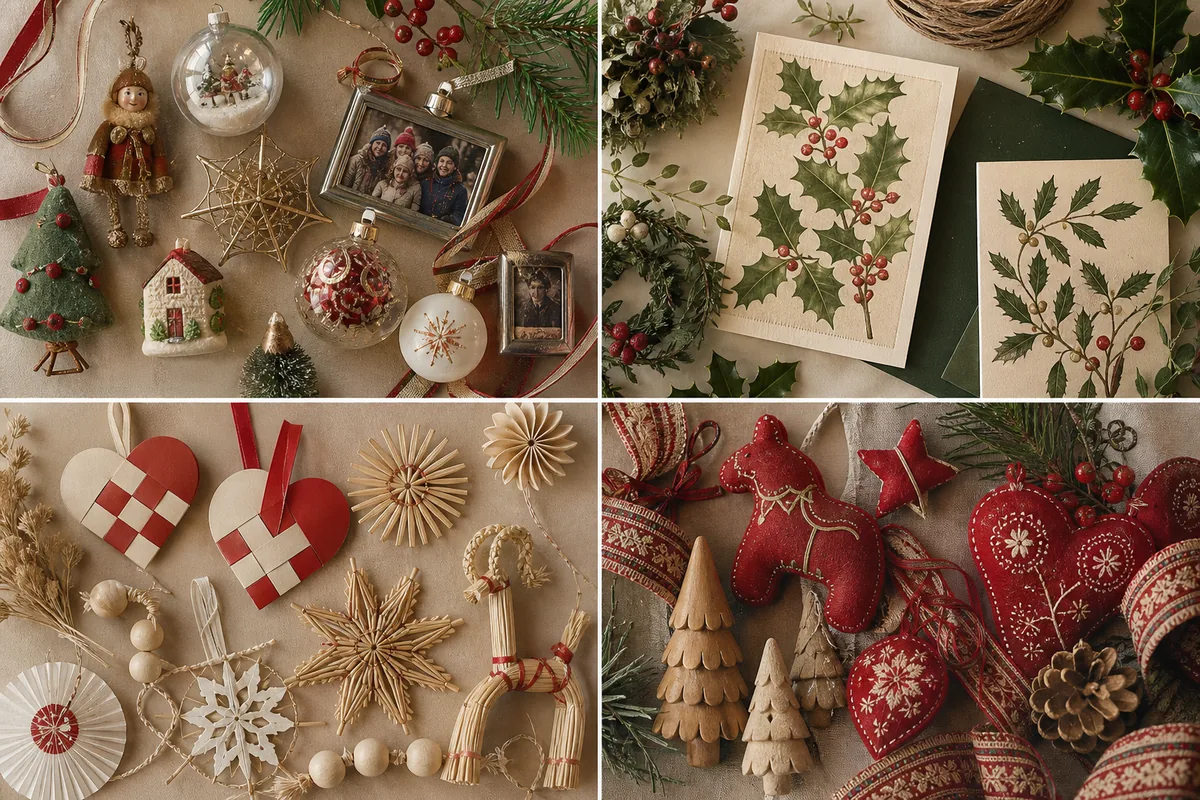
These labels describe broad design families, not fixed national rules: American styles often emphasize personal collections, British styles mix greenery and print traditions, Scandinavian styles favor graphic natural materials, and Alpine styles draw on mountain-region wood, textile, and carved forms.
American British Scandinavian and Alpine Christmas Craft Styles
“American,” “British,” “Scandinavian,” and “Alpine” are useful visual shorthand, but none describes a single uniform tradition. Each covers different regions, communities, periods, and religious or secular practices. Treat the styles below as design directions supported by selected historical associations—not rules about how everyone in a place celebrates. The most convincing modern project borrows a limited set of materials and motifs while naming its inspiration accurately.
American: personal collections and mixed inheritances
American Christmas craft imagery cannot be reduced to one national formula. A 1978 Smithsonian exhibition presented thirteen differently decorated trees, including community, religious, regional, immigrant, natural-material, needlework, and commercially influenced examples. That record supports a mixed-collection approach rather than a claim that one nostalgic look represents the country. Family objects can also carry memory and artistic meaning, as the National Museum of American History notes in its discussion of holiday collections.
Build this direction around a collection rather than a matching set. Repeat one connector—an 8-inch red ribbon loop, star shape, or date tag—across five ornaments in different materials. Consistent scale and hanging methods make the mixed pieces coherent.
Do not label one nostalgic commercial look as universally American. Indigenous, African American, Latin American, European American, and many other community traditions have distinct histories that require their own sources. If a motif comes from a living cultural tradition, research its maker and meaning instead of treating it as generic decoration.
British: greenery, printed greetings, and playful ornament
The Victorian period strongly shaped the Christmas imagery now associated with Britain. The V&A documents the nineteenth-century expansion of Christmas cards, crackers, decorated trees, manufactured ornaments, and home-centered family celebration. Surviving cards show that Victorian taste could be playful and eccentric as well as botanical.
For a British-inspired paper project, use warm ivory card, dark green relief-printed holly, a faded red border, and one unexpected small illustration. Make four 4-by-6-inch folded cards and matching 2-by-3-inch tags. A hand-carved block or purchased stamp evokes printmaking without falsely claiming antique production. Add handwritten messages after ink dries completely.
Greenery also suits this direction, but use it practically. A loose mantel garland should have an independently secured base and remain well outside the fireplace manufacturer’s clearance. Choose battery candles rather than open flame. Christmas crackers may be subject to venue or transport rules when they contain snaps; a reusable fabric favor wrap offers a quieter alternative.
Scandinavian: graphic forms, natural materials, and regional variation
Scandinavian design is often reduced internationally to white, pale wood, and minimalism. Actual Christmas traditions across Denmark, Norway, Sweden, Finland, and Iceland are more varied and can include strong reds, woven paper, straw, candles, textiles, painted wood, and abundant food and family ritual. The Nordic Museum notes, for example, that Swedish Christmas customs have changed through exchanges with wider European and Anglo-American traditions.
Create a graphic Nordic-inspired set using red and ivory paper hearts, simple folded stars, and one straw or wooden accent. Use the phrase “inspired by Scandinavian paper and natural-material traditions” unless the project follows a documented regional pattern. Woven Danish-style paper hearts require precise paired templates; test the weave with 3-inch paper strips before cutting decorative stock.
Avoid placing real candles near paper, straw, wood shavings, or dried foliage. The glow associated with Nordic winter interiors can be created with warm LED lights. Also avoid presenting a modern minimalist palette as ancient or universal.
Alpine: carved silhouettes, dense textiles, and mountain materials
“Alpine” crosses national borders, so it should not be treated as a nationality or single craft system. One documented reference is Swiss paper cutting from the Bernese Oberland and Pays-d’Enhaut. Swiss National Museum reporting traces Johann Jakob Hauswirth’s nineteenth-century cut-paper Alpine scenes and shows how contemporary makers continue to reinterpret those themes. That evidence supports a Swiss cut-paper reference; it does not make every wood, wool, bell, or mountain motif universally Alpine.
A practical Alpine-inspired group can therefore begin with symmetrical black-and-ivory paper silhouettes, then add red wool felt stars as an explicitly modern design choice. If you use 1/8-inch plywood trees, describe them as your own mountain-inspired silhouettes rather than a documented regional pattern. Keep bells lightweight, close wire ends into full loops, and test hanging weight.
Specificity matters. A Swiss paper-cutting reference, an Austrian carved figure, and an Italian mountain textile are not interchangeable merely because all are Alpine. Name the particular museum object, pattern source, or family artifact when one directly informs the design.
Compare palettes before combining them
Make four 5-by-7-inch sample boards before buying supplies: mixed keepsake materials and repeated red for American; evergreen, ivory, red, and black linework for British; red, ivory, straw, and pale wood for Scandinavian; warm wood, red wool, forest green, and white stitching for Alpine. View them in the intended room, select one primary direction, and borrow no more than one accent from another.
Borrow methods, not identities
The safest approach is to say what the project visibly does: “woven paper heart,” “Victorian-card-inspired tag,” “family keepsake ornament,” or “Alpine-inspired felt and wood palette.” Do not claim authenticity, age, or cultural ownership that the materials and research cannot support. Credit named patterns and contemporary designers, respect licenses, and purchase directly from tradition bearers when possible.
Regional style becomes richer, not weaker, when its limits are acknowledged. A modern maker can appreciate a printing method, paper structure, color relationship, or material tradition without compressing millions of people into four decorating formulas.
Sources
- Victoria and Albert Museum: Victorian Christmas traditions
- Victoria and Albert Museum: A brief history of Victorian Christmas cards
- Nordiska museet: Julafton
- Smithsonian: 1978 Trees of Christmas
- National Museum of American History: The objects of our traditions
- SWI swissinfo.ch: Paper cutting moves on into the 21st century