Western Christmas handcrafts do not have one origin; they developed through Christian observance, older seasonal customs, local household skills, expanding print culture, and nineteenth-century consumer traditions.
The Origins of Western Christmas Handcrafts
There is no single moment when “Christmas crafts” began. Familiar decorations emerged from overlapping histories: Christian observance, winter greenery, household skills, regional customs, commercial printing, and Christmas as a family-centered holiday. A paper star made today may look old-fashioned, but its materials and meaning are often modern. The most accurate approach follows individual objects rather than one origin story.
Evergreens came before the modern craft aisle
People in different European societies used living greenery during winter long before contemporary Christmas decorating. The Library of Congress notes that modern observances combine religious and secular customs from many cultures, including ancient Roman use of evergreens. This does not mean every wreath descends directly from one Roman practice. Green branches have been reused in changing religious, domestic, and civic settings because they remain visibly alive in winter.
For modern makers, the useful inheritance is material rather than a claim of exact continuity. A simple door bundle can be made from locally permitted evergreen cuttings, tied around a 12-inch branch with natural twine and finished with one ribbon. Wear gloves when handling resinous or prickly foliage, identify plants before bringing them indoors, and keep greenery away from heat sources, pets, and open flame. Never cut from private or protected land without permission.
The decorated tree moved through regions and social classes
Indoor decorated trees are strongly associated with German-speaking Europe. In Britain, the Victoria and Albert Museum explains that the custom became widely visible after an 1848 illustration showed Queen Victoria, Prince Albert, and their children around a decorated tree. The royal image helped popularize the practice, but it should not be simplified into the claim that Albert single-handedly “invented” the British Christmas tree.
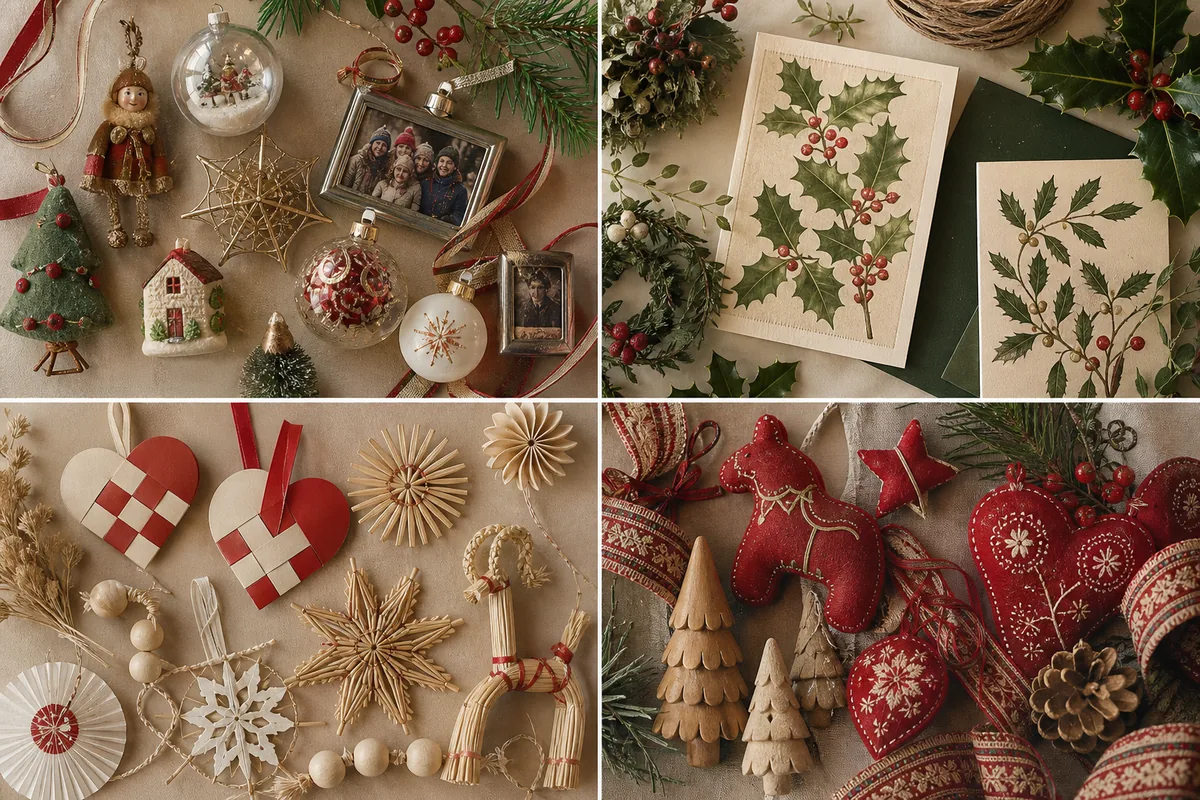
Early tree decorations could combine purchased reflective ornaments with candles, ribbon, fruit, sweets, and homemade items. Industrial production later expanded the range of glass and printed decorations. Handcraft and commerce therefore developed together: families could buy a new ornament while continuing to sew, bake, fold, or tie others at home.
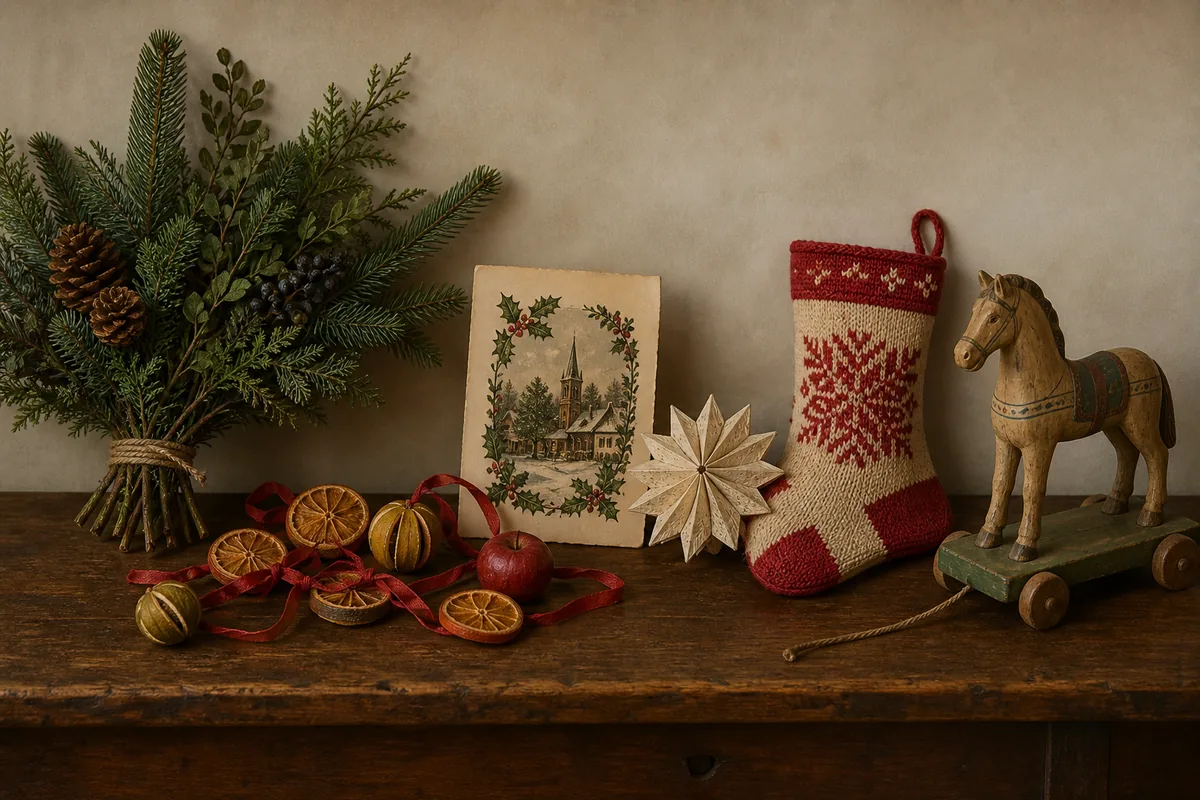
A historically inspired project does not need unsafe imitation. Replace tree candles with low-heat LED lights. Fold 4-inch paper stars, string dried citrus only after it is fully dehydrated, or sew lightweight felt shapes. Keep edible decorations separate if they have been handled with non-food-safe wire, glue, paint, or glitter.
Christmas cards joined handwork to printing technology
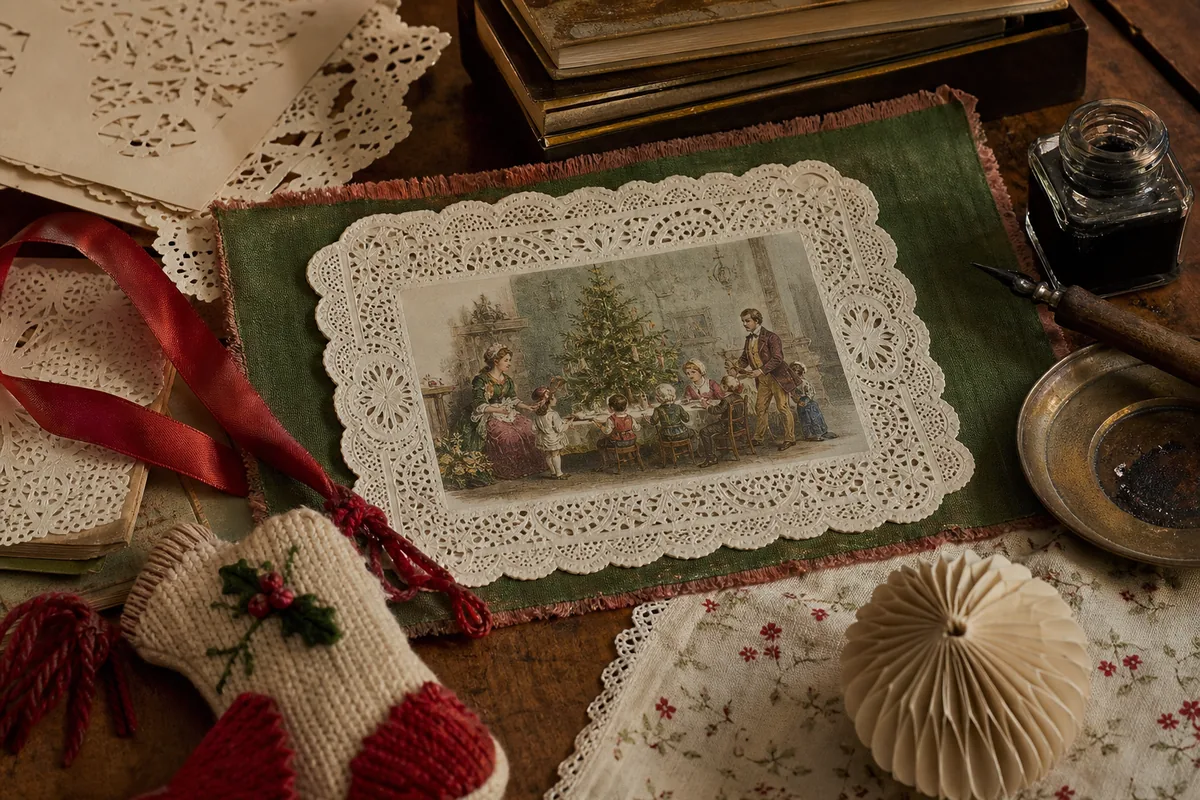
The V&A identifies the card commissioned by Henry Cole and designed by John Callcott Horsley in 1843 as the first Christmas card. Improvements in color printing and postal systems later made cards affordable to a broader public. Victorian examples were not limited to the restrained holly and snow scenes now labeled “traditional”; museum collections include comic, strange, and highly inventive imagery.
Cards blurred the line between manufactured and handmade objects. A printed image could be mounted on paper lace, fabric, or an embossed support, then personalized in ink. Today’s equivalent might use a carved rubber block or purchased stamp on folded cotton paper. Calling a hand-pressed relief card “letterpress” is inaccurate unless it was made on a press that creates that characteristic impression. Describe the actual process instead.
Household skills shaped ornaments and gifts
Many Christmas objects grew from skills already used during the year. Sewing produced stockings, stuffed figures, and fabric ornaments. Woodworking produced toys and tree forms. Paper cutting and folding produced stars, chains, and later printed decorations. Baking created edible gifts and ornaments. These were not one uniform Western tradition; materials depended on region, income, trade, religion, and what a household knew how to make.
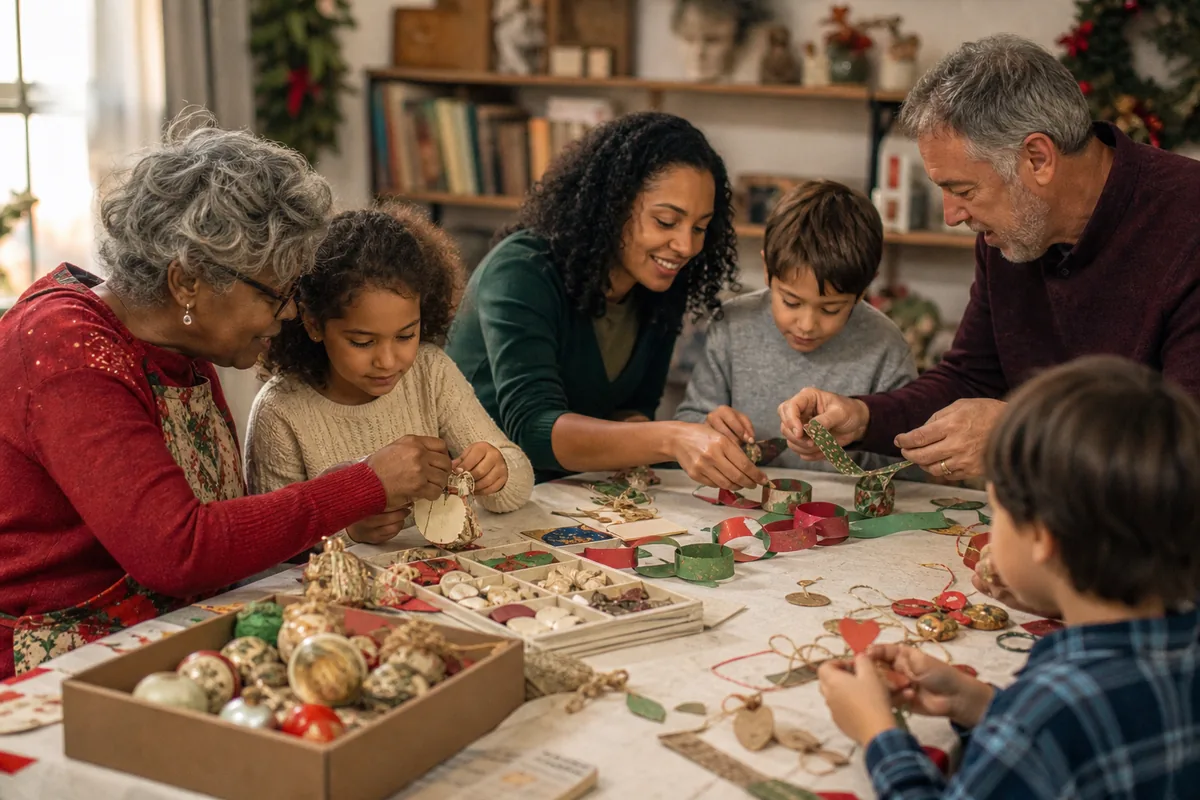
The Library of Congress preserves an American oral-history recollection in which Alan Wallace described his mother teaching the family to make gifts, a habit connected in his account to Civil War-era thrift. One recollection cannot represent every family, but it demonstrates how economic circumstances and transmitted skills could make handwork central to a particular Christmas memory.
When recreating an old family object, document what is actually known. Write “based on a paper ornament in a 1940s family photograph” rather than assigning a national origin without evidence. Photograph both sides, record dimensions and materials, and preserve the original separately if it is fragile.
The Victorian period reorganized familiar elements
In nineteenth-century Britain, industrialization, improved transport, print, and a growing consumer market changed Christmas substantially. The V&A connects this period with the spread of cards, crackers, decorated trees, commercial ornaments, and home-centered family celebration. The apparent contradiction between “handmade Christmas” and mass production is therefore part of the history itself. Printed templates, affordable colored paper, new dyes, and bought trimmings gave households more things to make with, even as factories sold finished decorations.
This is why age alone does not make a craft more authentic. A project is historically responsible when it identifies its inspiration, avoids invented certainty, and adapts hazardous practices openly. Battery lights, conservation-safe storage, and modern child-safety rules do not weaken a tradition; they allow the object to function in a present-day home.
Make tradition specific and honest
Choose one object—card, wreath, paper chain, stitched stocking, or tree ornament—and investigate its family or regional context. Use museum collections, dated photographs, diaries, oral histories, and surviving examples. Note where evidence ends and design choice begins. Then make a version suited to its real setting and label it with the year, maker, materials, and inspiration.
Western Christmas handcrafts are best understood as a continuing exchange between inherited skill, available materials, family memory, and new technology. Their value does not depend on proving an unbroken ancient lineage. It comes from knowing which parts are documented, which are adapted, and why a household chooses to make the object again.